

Synopsis of some of the most popular classical music compositions prepared for Internet radio's "a MUSIClassical Concert" at www.theClassicStation.com and www.ClassicalMusic.network
Showing posts with label Works-B. Show all posts
Showing posts with label Works-B. Show all posts
BACH Cello Suites


Offenbach "La belle Hélène" Overture


La belle Hélène (French pronunciation: [la bɛl elɛn], The Beautiful Helen), is an opéra bouffe in three acts by Jacques Offenbach to an original French libretto by Henri Meilhac and Ludovic Halévy. The operetta parodies the story of Helen's elopement with Paris, which set off the Trojan War. It was first performed at Paris's Théâtre des Variétés on December 17, 1864, starring Hortense Schneider and José Dupuis. While some experts (cf Grove) are of the opinion that the creation of La belle Hélène was a "largely untroubled" affair, others (cf Jacob) paint a different picture: Although Offenbach had managed at great cost to persuade Schneider, known by then as "La Snédèr", to accept the role of Helen, the premiere remained in doubt to the very last minute. During rehearsals, La Snédèr constantly complained that the extravagant Léa Silly (in a male role as Oreste) was trying to upstage her: La Silly extemporized (a privilege reserved for the prima donna); she imitated her; she danced a cancan in her back while she was singing an important aria, etc. etc. La Snédèr not only walked off the set repeatedly, but kept threatening to leave the world, or at least Paris, altogether! It took all of Offenbach's skills at creating harmony to see the production through. WIKIPEDIA
La belle Hélène was an instant success with both the public and the critics and enjoyed an initial run of 700 performances. Premieres in Vienna (1865), Berlin (1865), London (1866), and Chicago (1867) followed shortly. It also had a run in New York City at the Grand Opera House beginning on April 13, 1871. It had its Czech premiere in Prague in 1875, under Adolf Čech.
VIDEO: Overture to La belle Hélène The beautiful Helena Die schöne Helena by Jacques Offenbach (1819-1880) Vienna State Opera Orchestra
Berlioz Beatrice et Benedict overture


Béatrice et Bénédict (Beatrice and Benedick) is an opéra comique in two acts by Hector Berlioz. Berlioz wrote the French libretto himself, based closely on Shakespeare's Much Ado About Nothing. Berlioz had been interested in setting Shakespeare's comedy since his return from Italy in 1833, but only composed the score of Béatrice et Bénédict following the completion of Les Troyens in 1858. It was first performed at the Theater der Stadt, Baden-Baden on 9 August 1862. Berlioz conducted the first two performances of a German version in Weimar in 1863, where, as he wrote in his memoirs, he was "overwhelmed by all sorts of kind attention." It is the first notable version of Shakespeare's play in operatic form, and was followed by works by among others Árpád Doppler, Paul Puget and Reynaldo Hahn. Berlioz biographer David Cairns has written "Listening to the score's exuberant gaiety, only momentarily touched by sadness, one would never guess that its composer was in pain when he wrote it and impatient for death". WIKIPEDIA
VIDEO: Academy of St. Martin in the Fields, Sir Neville Marriner conducting. Overture to "Beatrice et Benedict," Berlioz. Carnegie Hall 1994.
Bach - Brandenburg Concerto No. 6 in B-flat major BWV 1051


The Brandenburg Concertos by Johann Sebastian Bach (BWV 1046–1051, original title: Six Concerts à plusieurs instruments) are a collection of six instrumental works presented by Bach to Christian Ludwig, Margrave of Brandenburg-Schwedt,[2] in 1721 (though probably composed earlier). They are widely regarded as some of the best orchestral compositions of the Baroque era. In the Brandenburg Concerto No. 6 in B-flat major BWV 1051 the absence of violins is unusual. Viola da braccio means the normal viola, and is used here to distinguish it from the "viola da gamba". When the work was written in 1721, the viola da gamba was already an old-fashioned instrument: the strong supposition that one viola da gamba part was taken by his employer, Prince Leopold, also points to a likely reason for the concerto's composition—Leopold wished to join his Kapellmeister playing music.
VIDEO: Herbert Blendinger, viola Ingo Sinnhofer, viola Oswald Uhl, viola da gamba Hans Dieter Kruse, viola da gamba Peter Steiner, cello Franz Ortner, double bass Karl Richter, Münchener Bach Orchester
Bach: Brandenburg Concerto No. 5 in D major, BWV 1050
 The Brandenburg Concertos by Johann Sebastian Bach (BWV 1046–1051, original title: Six Concerts à plusieurs instruments) are a collection of six instrumental works presented by Bach to Christian Ludwig, Margrave of Brandenburg-Schwedt, in 1721 (though probably composed earlier). They are widely regarded as some of the best orchestral compositions of the Baroque era.
The harpsichord is both a concertino and a ripieno instrument: in the concertino passages the part is obbligato; in the ripieno passages it has a figured bass part and plays continuo.
This concerto makes use of a popular chamber music ensemble of the time (flute, violin, and harpsichord), which Bach used on its own for the middle movement. It is believed that it was written in 1719, to show off a new harpsichord by Michael Mietke which Bach had brought back from Berlin for the Köthen court.WIKIPEDIA
The Brandenburg Concertos by Johann Sebastian Bach (BWV 1046–1051, original title: Six Concerts à plusieurs instruments) are a collection of six instrumental works presented by Bach to Christian Ludwig, Margrave of Brandenburg-Schwedt, in 1721 (though probably composed earlier). They are widely regarded as some of the best orchestral compositions of the Baroque era.
The harpsichord is both a concertino and a ripieno instrument: in the concertino passages the part is obbligato; in the ripieno passages it has a figured bass part and plays continuo.
This concerto makes use of a popular chamber music ensemble of the time (flute, violin, and harpsichord), which Bach used on its own for the middle movement. It is believed that it was written in 1719, to show off a new harpsichord by Michael Mietke which Bach had brought back from Berlin for the Köthen court.WIKIPEDIAVIDEO: From the "Spiegelsaal" Castle Cöthen (Schloß Köthen) Freiburger Barockorchester
Bach: Brandenburg Concerto No. 4 in G major, BWV 1049

The fourth Brandenburg Concerto is scored for violin, two flutes, strings, and continuo. The Fourth Brandenburg Concerto is unique in that it is the only of the six in which all instruments are used in all movements. Composition 1719–20 First Publication 1851 - Leipzig: C.F. Peters The Brandenburg Concertos by Johann Sebastian Bach (BWV 1046–1051, original title: Six Concerts à plusieurs instruments) are a collection of six instrumental works presented by Bach to Christian Ludwig, Margrave of Brandenburg-Schwedt, in 1721 (though probably composed earlier). They are widely regarded as some of the best orchestral compositions of the Baroque era. VIDEO: Soloists / Solisten: Gottfried von der Goltz: violin / Violine / violon Isabel Crijnen & Thera de Clerck: recorder / Blockflöte / flûte à bec Recorded at the Hall of Mirrors, Palace of Cöthen, 23-26 March 2000
Bach: Brandenburg Concerto No. 3 in G major, BWV 1048


The Brandenburg Concertos by Johann Sebastian Bach (BWV 1046–1051, original title: Six Concerts à plusieurs instruments) are a collection of six instrumental works presented by Bach to Christian Ludwig, Margrave of Brandenburg-Schwedt, in 1721 (though probably composed earlier). They are widely regarded as some of the best orchestral compositions of the Baroque era. No. 3 in G major, BWV 1048
VIDEO: From the "Spiegelsaal" Castle Cöthen (Schloß Köthen) Freiburger Barockorchester
Bach: Brandenburg Concerto No. 2 in F major, BWV 1047
 The Brandenburg Concertos by Johann Sebastian Bach (BWV 1046–1051, original title: Six Concerts à plusieurs instruments) are a collection of six instrumental works presented by Bach to Christian Ludwig, Margrave of Brandenburg-Schwedt, in 1721 (though probably composed earlier). They are widely regarded as some of the best orchestral compositions of the Baroque era. No. 2 in F major, BWV 1047
The trumpet part is still considered one of the most difficult in the entire repertoire, and was originally written for a clarino specialist, almost certainly the court trumpeter in Köthen, Johann Ludwig Schreiber. After clarino skills were lost in the eighteenth century and before the rise of the historically informed performance movement of the late twentieth century, the part was usually played on the valved trumpet.
VIDEO: From the "Spiegelsaal" Castle Cöthen (Schloß Köthen)
Freiburger Barockorchester Recorded at the Hall of Mirrors, Palace of Cöthen, 23-26 March 2000
Directed by Hans Hadulla,
The Brandenburg Concertos by Johann Sebastian Bach (BWV 1046–1051, original title: Six Concerts à plusieurs instruments) are a collection of six instrumental works presented by Bach to Christian Ludwig, Margrave of Brandenburg-Schwedt, in 1721 (though probably composed earlier). They are widely regarded as some of the best orchestral compositions of the Baroque era. No. 2 in F major, BWV 1047
The trumpet part is still considered one of the most difficult in the entire repertoire, and was originally written for a clarino specialist, almost certainly the court trumpeter in Köthen, Johann Ludwig Schreiber. After clarino skills were lost in the eighteenth century and before the rise of the historically informed performance movement of the late twentieth century, the part was usually played on the valved trumpet.
VIDEO: From the "Spiegelsaal" Castle Cöthen (Schloß Köthen)
Freiburger Barockorchester Recorded at the Hall of Mirrors, Palace of Cöthen, 23-26 March 2000
Directed by Hans Hadulla,
J.S. Bach - Brandenburg Concerto No. 1 in F major BWV 1046


The Brandenburg Concertos by Johann Sebastian Bach (BWV 1046–1051, original title: Six Concerts à plusieurs instruments) are a collection of six instrumental works presented by Bach to Christian Ludwig, Margrave of Brandenburg-Schwedt, in 1721 (though probably composed earlier). They are widely regarded as some of the best orchestral compositions of the Baroque era. Bach's dedication to the Margrave was dated 24 March 1721. Most likely, Bach composed the concertos over several years while Kapellmeister at Köthen, and possibly extending back to his employment at Weimar (1708–17). This concerto No. 1 in F major BWV 1046, is the only one in the collection with four movements. An earlier version (Sinfonia, BWV 1046a), which does not use the violino piccolo, may have been used for the opening of the cantata Was mir behagt, ist nur die muntre Jagd, BWV 208, which was first performed in 1713. This version lacks the third movement entirely, and the Polacca from the final movement, leaving Menuet – Trio I – Menuet – Trio II – Menuet. The first movement can also be found as the sinfonia of a later cantata Falsche Welt, dir trau ich nicht, BWV 52. The third movement was used as the opening chorus of the cantata Vereinigte Zwietracht der wechselnden Saiten, BWV 207. VIDEO: Pinchas Zukerman Members of the Los Angeles Philharmonic Orchestra
FINZI Five Bagatelles Op 15


Gerald Finzi - Five Bagatelles for Clarinet and Piano
RESPIGHI Brazilian Impressions


VIDEO:Ottorino Respighi Brazilian Impressions 1. Tropical Night 2. Butantan 3. Song and Dance Antal Dorati and The London Symphony Orchestra 1957
Respighi, The Birds (Gli Uccelli)

WIKIPEDIA

VIDEO: The Atlanta Symphony Orchestra performs under Louis Lane.
Sibelius The Bard - Symphonic Poem, Op64

WIKIPEDIA

VIDEO: Jean Sibelius Barden [The Bard] symphonic poem Op 64 Paavo Berglund Finnish RSO
Rachmaninov, The Bells Symphony Op 35

WIKIPEDIA

VIDEO: Boston University Symphony Orchestra Symphony Hall Concert April 2, 2012
FAURE Barcarolles

WIKIPEDIA
The title barcarolles implies no specific form. From the French meaning "trifle," it ... Other composers who wrote barcarolles for piano are Faure, Anton Rubinstein, Balakirev, Glazunov, and MacDowell


The Brandenburg Concertos by Johann Sebastian Bach
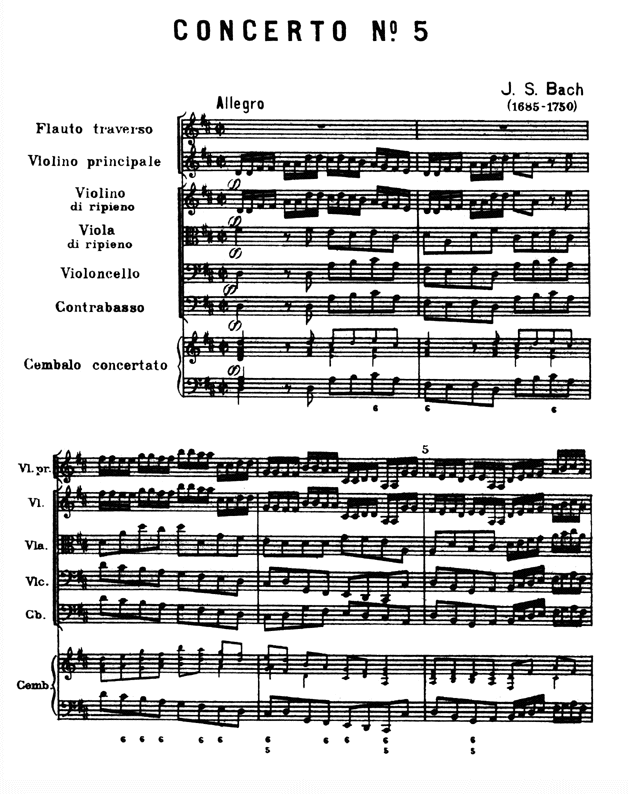
VIDEO: Bach: Brandenburg Concerto No. 5 in D major, BWV 1050 (Freiburger Barockorchester)
Berceuse by Faure
A Lullabye originally a berceuse for violin and piano composed in 1880.


Subscribe to:
Posts (Atom)
Popular Posts
-
 Shostakovich's orchestral works include 15 symphonies and six concerti. His chamber output includes 15 string quartets, a piano quinte...
 -
 William Boyce (baptised 11 September 1711 – d. 7 February 1779) was an English composer and organist. Boyce is known for his set of eight...
 -
 The Waltz in D-flat major, Op. 64, No. 1, Valse du petit chien, popularly known as the Minute Waltz, is a piano waltz composed by Frédéric...
 -
 Piano Concerto No. 2 in F major, Op. 102, by Dmitri Shostakovich was composed in 1957 for his son Maxim's 19th birthday. Maxim pr...
 -
 Mikhail Mikhailovich Ippolitov-Ivanov (Russian: Михаи́л Миха́йлович Ипполи́тов-Ива́нов; 19 November [O.S. 7 November] 1859 – 28 January ...
 -
 William Baines (26 March 1899 - 6 November 1922) was an English pianist and composer. He wrote more than 150 works for solo piano and ...
 -
 William Alwyn CBE, born William Alwyn Smith (7 November 1905 – 11 September 1985), was an English composer, conductor, and music teacher...
 -
 William Alwyn CBE, born William Alwyn Smith (7 November 1905 – 11 September 1985), was an English composer, conductor, and music teache...
 -
 Irish composer John Field was born in 1782 and died in 1837. He was the grandson of an Irish organist and the son of a violinist. His piano...
 -
 Brahms, Johaness SelectedWorks Johannes Brahms (7 May 1833 – 3 April 1897), was a German composer and pianist, and one of the leading musi...